IRC for Smart Mobility & Logistics — KFUPM

UI² Lab

The Urban Intelligence & IoT Lab (UI²) at KFUPM turns city-scale sensing and data into safe and secure decisions that benefits public safety and the environment - with the verification, validation, and safety assurance to deploy AI in cities at scale.

From city-scale data to decisions that can be trusted

UI² is a research and development laboratory at the Interdisciplinary Research Center for Smart Mobility and Logistics, focused on the safe prototyping, deployment, and scaling of the intelligence, sensing, and safety-assurance layer of urban mobility, transportation, logistics, and infrastructure systems.

We develop the methods that turn IoT and connected-infrastructure sensing, urban data fusion, digital twins, and learning-based prediction into decision-making that operates safely alongside human users. Our particular emphasis: how AI-enabled systems are verified, validated, and safely operated at scale.

Working closely with partnering labs, research centers, and other stakeholders who build the autonomy stack itself, UI² provides the simulation environments, instrumented testbeds, benchmarks, and assurance evidence aligned with emerging standards such as ISO/PAS 8800, UL 4600, and the NIST AI Risk Management Framework.

Vision & Objectives

To become a leading regional and internationally recognized hub for scalable and trustworthy urban intelligence — providing the methods, tools, and evidence that allow AI and IoT systems to be deployed safely, reliably, and accountably across mobility, logistics, and critical infrastructure.
  1. Urban intelligence for Saudi priorities. Solutions for traffic and transit, freight and last-mile logistics, ports and terminals, utilities, and smart-city monitoring.
  2. National AI assurance capability. Simulation environments, digital twins, instrumented testbeds, and benchmarks aligned with ISO/PAS 8800, UL 4600, and the NIST AI RMF.
  3. Quantified risk management. Modeling and containing rare failures, cascading effects, and performance degradation under distribution shift.
  4. High-impact V&V research. Internationally competitive methods for rare-event evaluation, uncertainty quantification, formal and statistical assurance, and runtime monitoring.
  5. Strategic partnerships. Co-developing assurance solutions with transportation, logistics, energy, and technology partners — and supporting regulators with independent, evidence-based assessment.
  6. Talent in trustworthy AI. Training researchers across the full lifecycle: sensing, modeling, validation, certification evidence, deployment, and monitoring.

Five Focus Areas

IoT & Connected Sensing

Distributed and event-driven sensing for roads, transit, utilities, and logistics networks — the data layer of the intelligent city.

Digital Twins & Simulation

High-fidelity urban digital twins fusing live sensor data with simulation for scenario testing, benchmarking, and rehearsal before deployment.

Learning-Based Prediction & Optimization

Data-driven forecasting and optimization for traffic, freight, and infrastructure operations — designed for the constraints of real deployments.

Decision-Making Under Uncertainty

Sequential and risk-aware decision-making for systems that share streets, skies, and networks with people.

Verification, Validation & Assurance

Rare-event and long-tail evaluation, uncertainty quantification, runtime monitoring, and the assurance evidence needed for certification and regulatory acceptance.

Project Showcase

Duckietown: Benchtop Urban Autonomy

Teacher-guided reinforcement learning for lane keeping and full-loop driving in a Duckietown-style environment, the software stack for our upcoming physical Duckiebot city, where algorithms graduate from simulation to hardware.
Safe UAV Navigation & Aerial Monitoring

Safety-aware deep RL for quadrotor flight in confined, GPS-denied spaces, tunnels, pipes, tight urban corridors, with barrier-inspired constraints on clearance and motion, built on gym-pybullet-drones; plus MDP benchmarks for aerial surveillance planning.

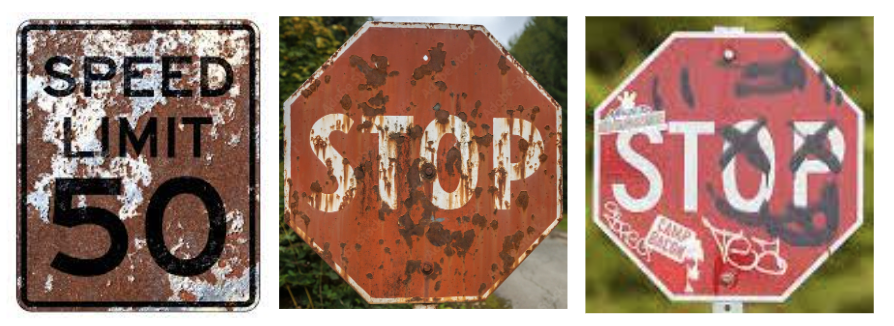
Weathered and rusty traffic signs used for data augmentation

Infrastructure-Aware Sensing

Real streets have rusty, faded, occluded signs. We build data augmentation and evaluation suites that stress perception against real-world infrastructure degradation, and point toward IoT-based monitoring of the infrastructure itself.

Urban Sensing from Street Infrastructure

The city itself can sense: a traffic-light camera watches vehicles queue, cross, and clear a CARLA Town10 junction while pedestrians use the crosswalks, the first eye of an instrumented-city stack feeding digital twins and city-scale decision-making.

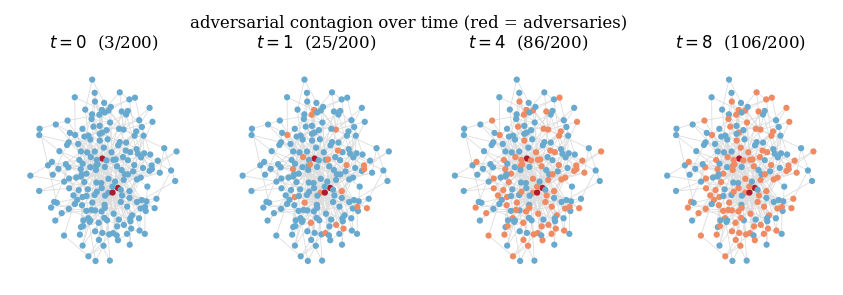
Adversarial contagion spreading across a multi-agent network over time

Resilience of Connected Fleets

When agents share a network, failures spread like contagion. We model adversarial and benign cascades across multi-agent systems, derive detection bounds, and design topologies that contain the spread.

Logistics & Freight Intelligence

From open-pit haulage fleets to multi-echelon supply chains: simulation-driven dispatch, forecasting, and bullwhip-effect analysis for the logistics systems that keep cities and industry supplied.